The 1940s and 1950s were chock-full of Christmas movies. I could have done an episode that is hours long to cover them all, but instead, I will cover some of my favourites. Even then, it was difficult to choose just a few. I had to leave a lot off this list.
Something I also noticed… Several Christmas movies were made in 1947. I think after years of The Great Depression, then WWII, people were getting back into the spirit.
In this video, we will talk about the fabulous fashion from some of those movies!
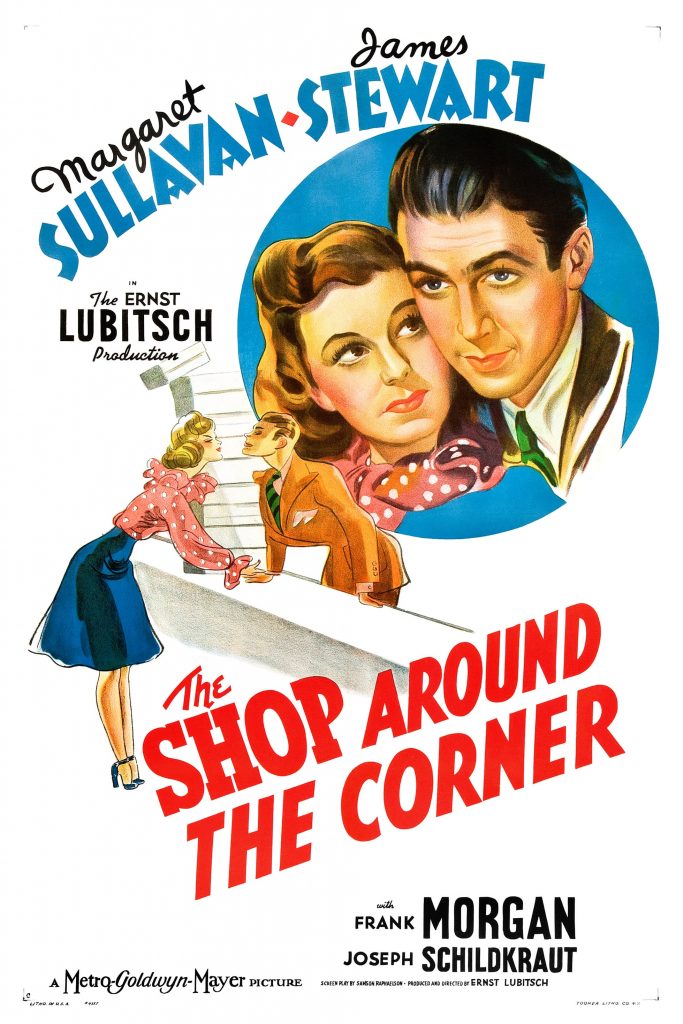
The Shop Around The Corner 1940 – Margaret Sullavan
This is one of my all-time favourites. It’s tied with A Christmas Story 1983. This movie is whimsical and absolutely delightful! It stars Jimmy Stewart and Margaret Sullavan. The wardrobe for The Shop Around The Corner oddly does not have a specific wardrobe designer.
This movie was released in 1940, so you will still see style influences from the late 1930s, such as soft lines, puffy sleeves, and romantic looks. This definitely comes across in one of my favourite all-time billowy blouses! This is on my list of makes. How can you not fall in love with the floaty, polkadot fabric!
Speaking of romantic, and I’m not just talking about how Jimmy Stewart looks at Margaret Sullavan, look at these dresses!
It’s A Wonderful Life 1946 Donna Reed
Six years later, we see Jimmy Stewart in another accidental Christmas movie, It’s A Wonderful Life. I think it might be time to do a video about Jimmy; he is truly my favourite. This movie also stars the lovely Donna Reed. Edward Stevenson was the costume designer.
Donna’s wardrobe is beautiful and classic. This includes dresses, blouses, and skirts. Also, she is so sweet in this movie!
There aren’t the severe shoulders that you see in film noir movies. Which makes sense because this movie does cover years from 1919 to 1945. I think they also wanted to give Donna a softer look.
Miracle on 34th Street 1947 Maureen O’Hara
I’m not a huge fan of Christmas; I’m a Halloween girl. However, the movies on my list are charming and give me hope that I can rewrite my negative memories of the day with more positive ones.
Miracle on 34th Street has another stellar cast that includes John Payne and Edmund Gwynne, but we are here to talk about Maureen O’Hara!
Maureen wears a few lovely dresses in this movie that are geared to business attire. Her character, Doris Walker, is an Events Manager at Macy’s. She also has this luscious coat. However, the standout piece is a suit. It has a bit of a military look to it, almost reminiscent of a nutcracker, which makes sense, since Macy’s puts on a Santa Claus parade.
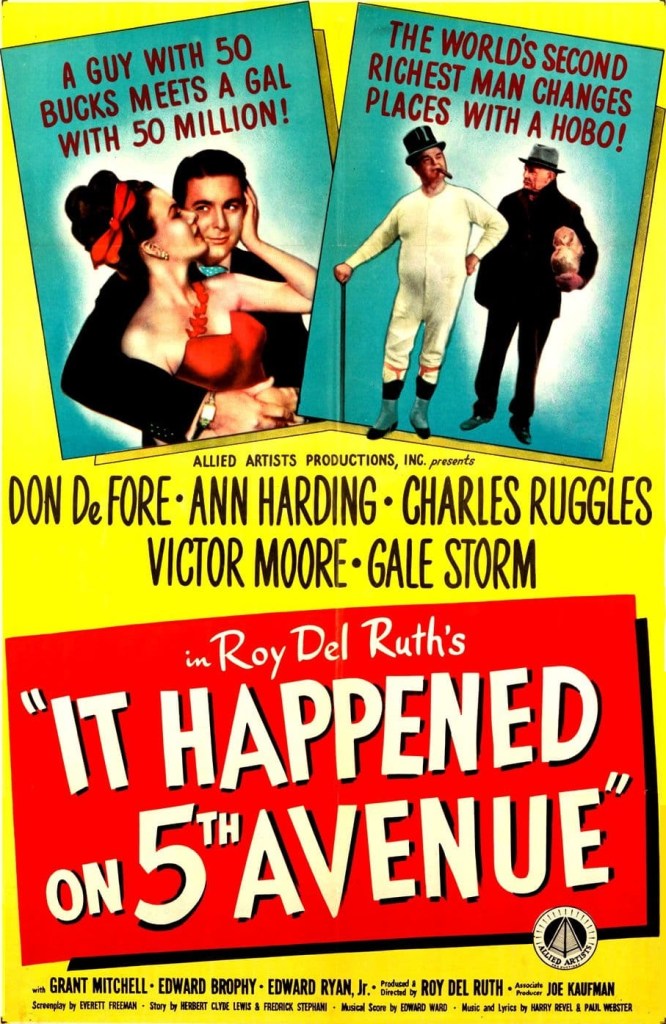
It Happened on 5th Avenue 1947 Gale Storm
Another classic from 1947 is It Happened on 5th Avenue. This movie stars Gale Storm. Such a great name!
Gale has a few lovely pieces in this movie, including this dress, this blouse, and this skirt, but it is the coat that is the prize winner for me. I’ve been dreaming of making a faux fur version of it.
The Bishop’s Wife 1947 Loretta Young
Give me a Cary Grant movie any day of the week. Pair him with Loretta Young and I’m in Heaven… see what I did there…
Another classic wardrobe, Loretta wears some very flattering dresses and fabulous coats! Adrian was the designer for the wardrobe for this movie.
Bell, Book & Candle 1958 Kim Novak
We are now going to skip ahead 11 years to the year 1958. This is an accidental Christmas movie, and when I say that, I mean the movie just happens to take place around Christmas time. This is another Jimmy Stewart classic and also Stars Jack Lemmon; however, it is the absolutely stunning Kim Novak who steals this entire movie, along with her cat Pyewacket, and her wardrobe.
By this point in the month, if you are one of my Patreon subscribers, you will already know that this is the theme for the monthly project. I was inspired by Kim Novak’s Wardrobe from this movie, including the use of the color red. Also, the entire movie has a wonderful witchy vibe to it, so that is absolutely what has drawn me in, and hands down, this is one of my favorite Christmas movies.
The use of black and other neutral colors is the perfect base for her wardrobe. Then throw in a splash of red and animal print, and you have the ultimate capsule wardrobe. Let me just show you a few of those pieces.
What are your favourite Holiday movies? Are you a Christmas person or a Halloween person? What are your favourite outfits from the movies I mentioned?
Thank you for watching! I hope you enjoyed this episode. Please subscribe and tell your friends! Subscribing and clicking the notification bell icon ensures you won’t miss a video!
When you hear the words, Film Noir what actresses immediately come into mind? Joan Crawford? Barbara Stanwyck? Joan Bennett? Ingrid Bergman? Ida Lupino? Gloria Grahame? Gene Tierney? Lizbeth Scott? Jean Simmons? Lauren Bacall? I’m sure at least one of these actresses is familiar to you. When you think of Film Noir fashion, these women are true icons! In this episode, we will look at some of the incredible garments worn by these women in this dark and moody genre.
Before I get started, for those who aren’t familiar with Film Noir, I wanted to give a brief overview of what it is and point out that Film Noir wasn’t just popular during the 1940s; there are many incredible movies in the 1950s as well.
What is Film Noir?
Film Noir is a style of Hollywood crime drama that emphasizes cynical attitudes and motivations. The 1940s and 1950s are generally regarded as the “classic period” of American Film Noir. Film Noir of this era is associated with a low-key, black-and-white visual style that has roots in German expressionist cinematography. Many of the prototypical stories and attitudes expressed in classic noir derive from the hardboiled school of crime fiction that emerged in the United States during the Great Depression, known as noir fiction. (Wikipedia)
As I mentioned in my intro, some actresses immediately come to mind when you think of Film Noir. However, so many more talented women graced the big screen. Unfortunately, I won’t have time to show you the wonderful wardrobes of all of them; rather, I am going to focus on a few actresses and particular movies.
Barbara Stanwyck
First up, I am starting with who I consider the Queen of Film Noir, Barbara Stanwyck.
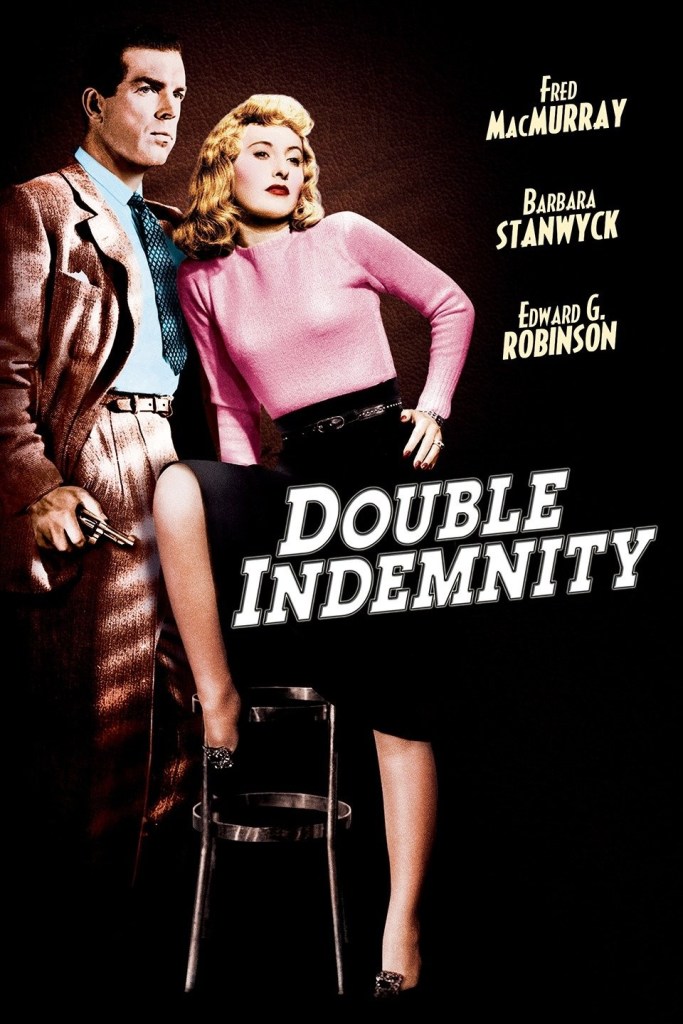
Barbara is most likely best known for her sassy characters in pre-code movies such as Baby Face, but she is also an iconic Film Noir actress. The movie wardrobe I am going to focus on today is from the movie Double Indemnity. The one and only Edith Head styled Barbara’s wardrobe.
Though colourized, this poster also shows her sexy style. The turtle neck with the A-line skirt! Classic!
Next up is this fun frilly number! I love that the frill is the centre piece of the dress.
Then we have the iconic little black dress. These are often seen in noir, although the term “little black dress” gained more fame in the 1950s due to Audrey Hepburn.
And the blouses, we can’t forget the blouses! I love the tropical print.
Ida Lupino
Next, I want to talk about the prolific Ida Lupino. She was the absolute trifecta of Hollywood talent. She was an actress, Director, and Writer. Ida is an inspiration to me on so many levels. Her wardrobe in the 1941 classic High Sierra is simple and wonderful. It’s a mix of blouses, trousers, a classic coat, and of course… frills! Milo Anderson styled Ida’s wardrobe
I want to start off with blouses. When we think of women’s clothing from the 1940s, we immediately visualize those big, boxy shoulders. Especially on suit jackets and coats. That look didn’t emerge until the mid-1940s. At the beginning of the 1940s, styles were still transitioning from the 1930s with a softer look. Slightly puffy shoulders and more romantic styles. High Sierra was made in 1941, so we are still seeing that late 1930s influence.
Trousers are also very present in this movie. I love me a good 1940s wide-legged trouser.
The most iconic piece of wardrobe for me is the coat! I love that wide collar and the tie belt!
Ingrid Bergman
We can’t talk about Film Noir without mentioning the movie Casablanca and, of course, Ingrid Bergman!
The piece that stands out the most in this movie is the hat!
The classic 2-piece suit is also an iconic look in this movie and many Film Noir movies.
Of course, I also need to talk about this pinafore-style dress. I’m not sure if it is one or two pieces, but look how lovely the stripes and plain colour dress work together.
Gene Tierney
I have such a soft spot for the movie Laura (1944). Not just because it stars Gene Tierney, but also because it stars my favourite ghoul, Vincent Price. This movie has an incredible cast, including Clifton Webb and Dana Andrews. However, this is about Gene.
One of my favourite wardrobe pieces in this movie is the dresses. They are romantic, floaty, and sexy without being over the top. Designer Bonnie Cashin did an incredible job dressing the character Laura.
Joan Crawford
As we begin to round out Film Noir of the 1940s, we have to chat about an actress who had covered many genres by the time the 1940s rolled around, including Silent Cinema and Pre-code. I am, of course, talking about the incredible Joan Crawford!
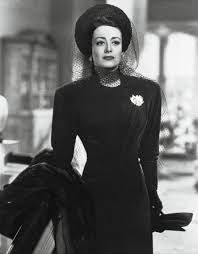
She starred in many Film Noir, but the wardrobe that stands out for me is from the movie Mildred Pierce (1945)! Once again, we see Milo Anderson as the costume designer.
Throughout this entire movie, you see that famous silhouette, the large shoulders! Of all actresses, Joan Crawford wore it best!
I am going to show you a few of my favourite pieces from the movie, including this polkadot number.
Marie Windsor
I am going to end this with one of my favourite noirs from the 1950s. I know! Some of you are likely yelling, What about Lauren Bacall, Lizbeth Scott, Jean Simmons, and Gloria Grahame, plus the very long list of other actresses! I would love to chat about them, too, but this video would be too long. If you want a second part, let me know, and I will do more.
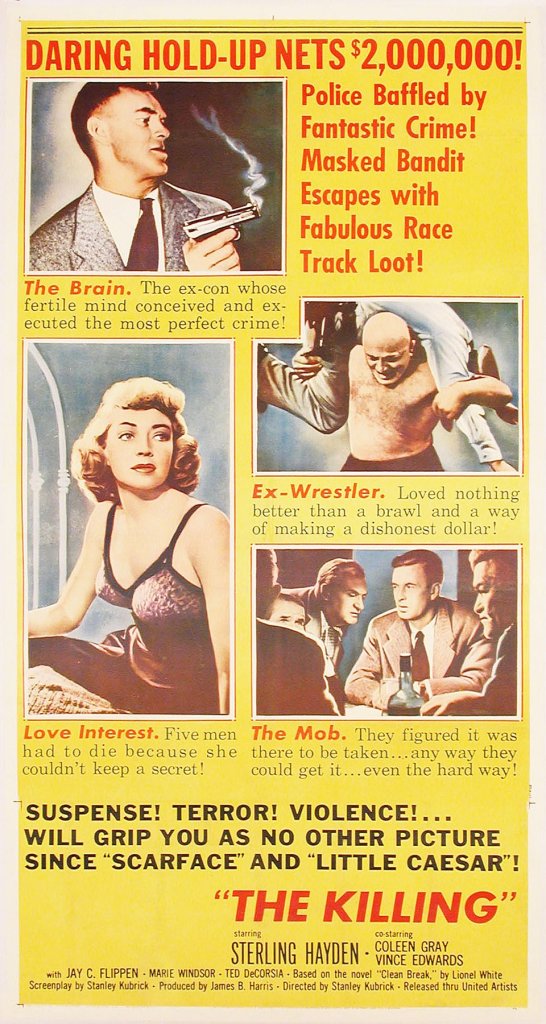
One of my favourite actresses from the 1950s is the very sexy Marie Windsor. If one of her movies is on, no matter when it starts, I will watch it. For this episode, we will talk about the 1956 movie, The Killing. The wardrobe was skillfully done by designer Jack Masters One thing that the 1950s did well was lingerie. Lower-budget movies, like many noirs, have some of the most desirable, flowing pieces I’ve ever seen. Marie Windsor also wears it well!
I hope you enjoyed my latest episode! If you did, please give me a thumbs up, subscribe, and let me know your favourite Film Noir movie or costume!
It’s starting to feel a lot like Halloween! When this time of the year rolls around, I begin to ramp up on my watching time for scary and spooky movies. I love kicking off the season with two of my favorites. Carrie and Carnival of Souls. In this video, I’m going to talk a little bit about the movie as well as the wonderful costuming that gives it that extra little eeriness. If you want to find out more, watch this video.
Halloween is creeping up on us. I look forward to this time of year and eagerly anticipate the crispness of the air and the crunch of fallen leaves. To some, this signifies the end of the year, but for me, it feels like a beginning. I await the shorter days and longer nights and, of course, sweater weather! I am an Autumn girl.
As I mentioned in the opening, when this time of year rolls around, I start ramping up my watch time of spooky movies. Whether they are horror, suspense, or beautiful ghost stories. Carrie is my first go-to to and then Carnival of Souls is next. I also want to mention that for my birthday, a good friend gifted me a signed copy of Candace Hilligoss’ promotional shot from the movie!
In this video, I am going to chat about the movie, the costuming, and of course, Candace Hilligoss.
To start, let me tell you what the movie is about. Also, you really need to watch this movie. It has become a cult classic and is an inspiration to many filmmakers, such as Wes Craven and Martin Scorsese, and horror enthusiasts.
Carnival of Souls was released in 1962 and can be best described as a psychological horror film. It is incredibly creepy. I am going to talk a wee bit about the plot of the movie here. I won’t give too much away, especially if you want to watch it. There are copies of it on YouTube and Tubi. On Tubi, there is both a black and white version and a colour version. The original movie was made in black and white, and I recommend you watch that version. The director Herk Harvey uses light and shadow to create the atmosphere, and you lose that in the colour version.
In this movie, Candace Hilligoss plays Mary Henry. Mary somehow walks away from a fatal car crash. This drives her to want to start life over again, including moving to another state. Mary is a very talented organist and finds work at a local church. While living in a rooming house, she not only has to deal with her creepy and inappropriate neighbour (the fabulous Sidney Berger), but she also begins having terrifying dreams and visions of a nearby, abandoned carnival.
I personally feel that Candace executes the role of Mary incredibly. You can feel her pain and isolation.
I’m going to leave the movie plot here. Please go watch it.
Before I talk about who Candace Hilligoss is, I want to get to the costuming first. It truly adds a lot of layers to the story and the visuals of this movie.
Carnival of Souls was a low-budget movie. They only had a budget of 33,000 dollars and even in 1962, that wasn’t very much money to work with. We’ve seen this in many other movies, including those by director Roger Corman. In many instances, actresses would use their own clothes. There hasn’t been anything that I could find that it was the case here as well. The director Herk Harvey was not only the director and producer, but he also had a hand in the costume design. In order to stay within budget, all of the costumes were very simple. You will even see this with the ghouls. They were dressed in the clothing of the time, including Mary’s clothing.
Mary wears very simple, classic shapes, including a few shirtwaist dresses, a sweater set and a gathered skirt. Very easy to wear pieces that work for her character.
The actors playing the ghouls were portrayed by local theatre students from the University of Kansas. They all supplied their own costumes that were also basics. Leotards, skirts, and trousers. Being theatre students, they also did their own make-up. They truly captured the look of the ghouls. The main ghoul was dressed in a simple suit with a tie and a white shirt. Giving a funerary feel to it.
So… back on my capsule wardrobe kick. Mary’s outfits from this movie would make a great basis for one.
Speaking of Mary! Let’s talk about the actress who played her, Candace Hilligoss.
I am currently reading her biography, The Odyssey and The Idiocy, Marriage to an Actor, A Memoir. I wasn’t sure how good it would be, but it’s actually a fun read and has some really humorous moments.
Mary Candace Hilligoss was born on August 14, 1935, in South Dakota. After completing university, like so many other actors, she made her way to New York City to begin a career in theatre. She studied at the Actors Studio and worked with Sanford Meisner and Lee Strasberg.
Before becoming an actor, Candace was also a model.
Candace didn’t end up in that many movies. After Carnival of Souls, she was in another horror movie called The Curse of the Living. We will be showing this in November at our monthly movie series, Killer B Cinema.
She also had small roles in a few TV shows, including Quincy M.E.
Her acting career wasn’t long, but she became a cult movie figure.
Candace went on to marry Nicolas Coster and have two daughters with him, and this marriage is the theme of her memoir.
I hope you enjoyed my little kick-off to Halloween season! Let me know if you are going to watch this movie or if you’ve seen it before. Also, let me know what you do to kick off Halloween!
If you enjoyed this video, please subscribe, give this video a thumbs up if you liked it and also, I now have memberships on this channel and those memberships do include early access to weekly videos, eventually I’ll do semi-regular members only chats, you’ll get discounts to new products, I’ll also do some members only posts, videos and possibly some tutorials shortly. It doesn’t cost that much to join, and it helps out my channel.
When you hear the word sweater girl your mind might automatically go to Marilyn Monroe or the many curvaceous women of the 1950s. However, the term sweater girl and the fashion itself started long before that. If you want to find out more about the origins of the sweater girl, watch this video.
It’s the mid-1940s, and the world is at war. Many young men are off to fight the biggest battle of their lives and are likely away from home for the very first time. They’re also incredibly stressed out. During this time, women’s fashion was also changing drastically, and one of those changes was the sexy, tight-fitting sweater. Not only was this a way for women to show off their curves, but the sweater girl also became a symbol of World War II and a way to help distract men from their daily lives as soldiers. That isn’t when the sweater girl trend began. It actually started much earlier than that, and the original model for the sweater girls was not Marilyn Monroe, as many people believe.
To learn the origins of where the sweater girl started, we need to go back to the year 1937. Before we dive into the history, let’s just talk a little bit about what exactly a sweater girl is.
The sweater girl was a 1940s and 1950s fashion trend that originally was very popular amongst Hollywood actresses, and as with a lot of fashion trends, young women started to emulate the way that these actresses looked. For many, it was a way to express their sexuality in a time when women were still supposed to look a certain way. That style itself was also very controversial, as many would say that women dressing in such a sexy way was showing society’s moral decline. When in fact this was giving women a sense of empowerment, and of course, many didn’t like that.
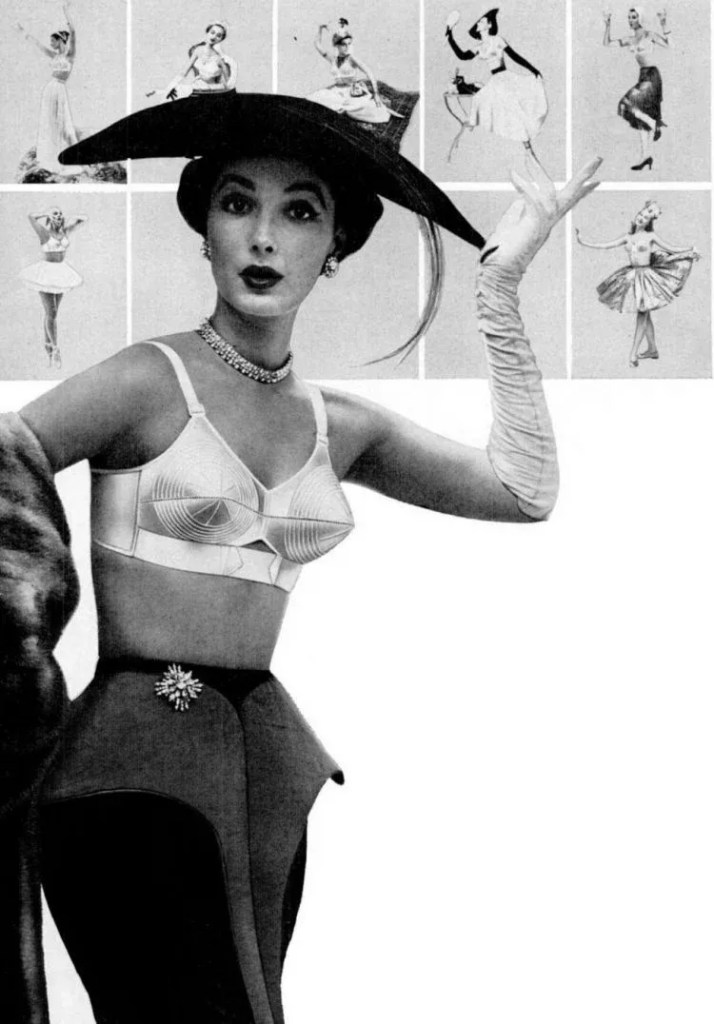
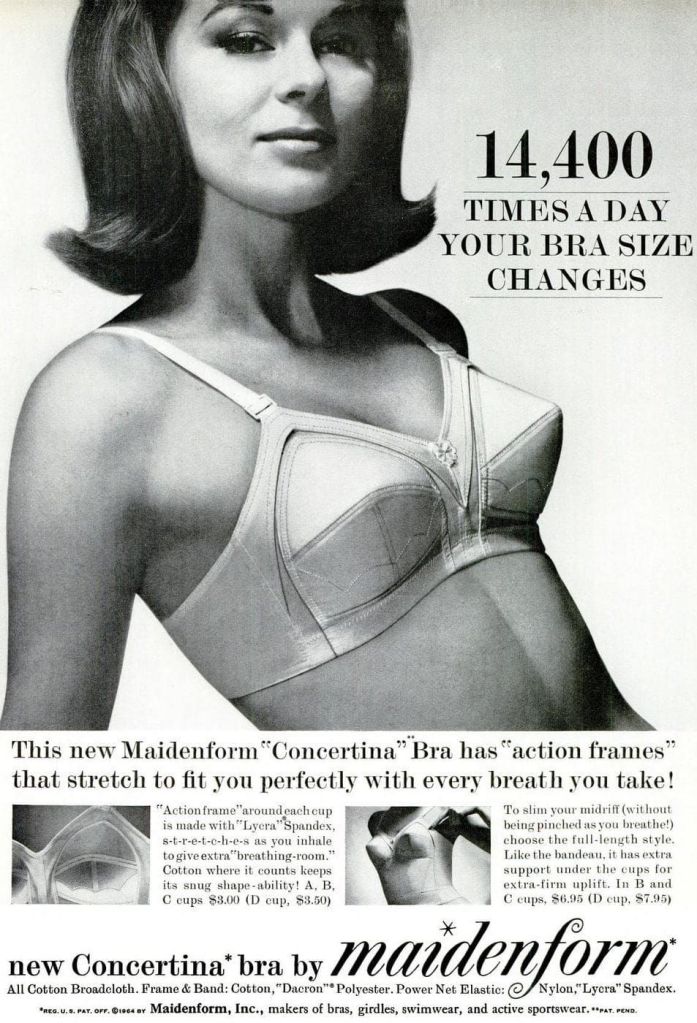
To add to the sexiness of the very fitted sweater, it was often worn with bullet bras and either pencil skirts or capris, or other tighter-fitting pants. You even see photos of women wearing tight-fitting sweaters with shorts.
Let’s get into the history of the origins of the term sweater girl.
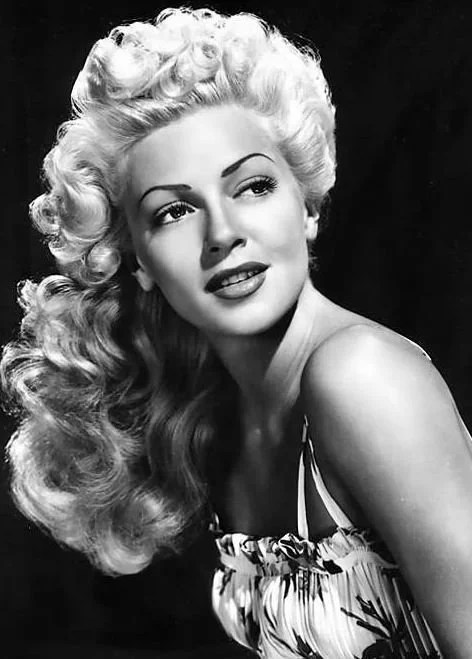
It’s said that the original actress who encapsulated the ultimate sweater girl was Lana Turner. She was dubbed sweater girl in 1937 after appearing in a very sexy fitted sweater in the film They Won’t Forget. Trust me, no one forgot how absolutely sexy she looked. From that moment on, other actresses realized how much attention they could get with these very snug-fitting garments and also began wearing them. This new fashion trend then created what the world viewed as a new version of a sex symbol.
It’s also said that Lana Turner’s picture was very popular with soldiers during World War II. Along with Lana, soldiers would have many photos of other actresses and pin-up models with them. Apparently, this was a source of comfort for them, and it helped them a bit when they were homesick. It was also a great way for them to be distracted from the horrors going on around them.
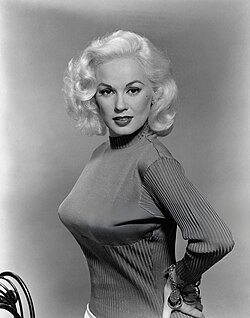
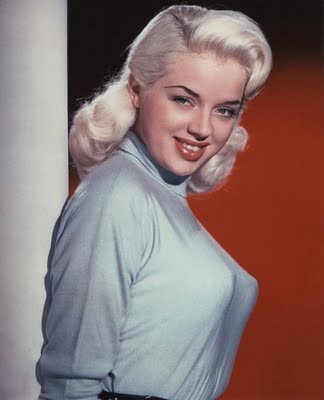
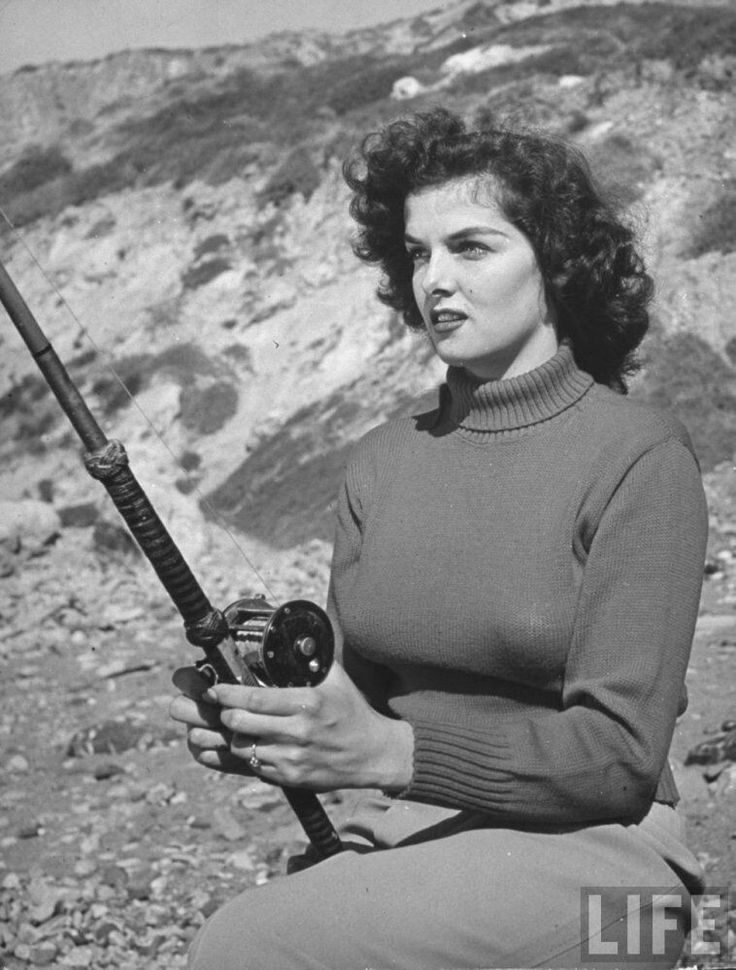
The popularity of the sweater girl grew when actresses such as Jayne Mansfield, Jane Russell, Patti Page, and, of course, Marilyn Monroe started also wearing the tighter-fitting sweaters.
The styling of the tight-fitting sweater could be in a variety of different ways. It could be plain with either a turtleneck or some variation of a scoop neck, and occasionally a V-neck, but not as often. Very often, as well, they would be embellished with either embroidery, sequins, or some sort of beading. Often, you would see these in sweater sets as well. These beautiful sweaters not only highlighted the beautiful hourglass figures due to their form-fitting shape, but they also got a little bit of help with the famous bullet bra.
At this time, we were also seeing more progress in the way that fabric was being made. You could get fabric for sweaters that was made with cashmere or angora, and even yarn for knitting that had become softer. It wasn’t that itchy scratchy wool any longer. Because fabrics such as cashmere and angora fabrics could also be made thinner and this would also add to the ability to have it more form-fitting. Occasionally, sweaters would also be made with cotton, though at that time, I don’t think cotton would hold up as well as wool. I feel like it would have eventually lost shape a little bit. Over time, of course, cotton did improve with technology.
I absolutely love the look of bullet bras, and they’ve become very, very popular in today’s pin-up culture and rockabilly culture. The sweater girl look has never really vanished. Many companies make modern versions of the bullet bras, as well as you can still find vintage ones. Unfortunately, a lot of vintage lingerie and underpinnings don’t hold up to newer ones. In a lot of cases, the elastic fabric needed for flexibility in a brassiere often deteriorates, and a lot of the structure is lost because of that. Though I do see a lot of vintage lovers posting about finding original bullet bras. I’m sure if you are somebody who sews or you know somebody who does, parts of that bra can be fixed in order to make it wearable again.
As I mentioned earlier with the evolving exposure of the women’s figure can cause controversy around the tight-fitting sweaters. another clutch your pearls moment of women wanting to show off their bus lines and their wastes. Many felt that this was the moral downfall of youth post-World War II, even though this trend started before the war. According to a couple of articles that I read about this, they were saying that the bobby sockers were the worst influencers of all of the women. During this time, bobby soxers were usually either teenagers or women in their early twenties. I think every generation picks that sort of age range to blame for the downfall of society.
Two coeds looking at poster advertising the San Souci Club at Arlington State College, 1958
There is even a movie called The Sweater Girl. The Sweater Girl is a 1942 film that was written by Robert Blees and Beulah Marie Dix, and it was directed by William Clemens. This movie also starred actors Eddie Bracken, June Preisser, Philip Terry, and Betty Jean Rhodes. The movie was a low-budget comedy, and the plot is about college students attempting to solve a series of murders on campus, while at the same time, they’re trying to put on a big show for the school.
Then, in 1944, Navy Screen Magazine did a one-reel short that showed portions of the special Armed Forces Radio Network recording session. This session was with Bob Hope, where he introduces Judy Garland as a sweater girl before she begins to sing Over the Rainbow. Apparently, Garland asked Bob Hope why he thought that the men in the audience were so crazy about sweater girls, and of course, in his wisecracking lines, he said, “That’s one mystery I’d like to unravel”. Very typical of Bob Hope of that era.
As I mentioned in the video, here is a guide if you would like to try out the sweater girl look!
1. Sweater & Top
Fit: Choose a form-fitting sweater that hugs the bust and waist. Stretchy knits or wool blends work best.
Neckline: Crew neck, scoop neck, or slightly sweetheart-shaped. Some vintage styles had subtle puffed shoulders.
Length: Tuck the sweater into your high-waisted skirt or pants to emphasize the waist.
Colors: Pastels, red, black, or cream were classic. Solid colors are more authentic than bold prints.
Optional Details: Buttons or small embellishments, like a tiny bow or knit pattern, add retro charm.
2. Skirt & Bottoms
High-Waisted Pencil Skirt: Knee-length or just below the knee, fitted but not overly tight.
A-Line Skirt: Offers a softer, more playful look while still accentuating the waist.
Wide Belts: Cinch the waist further; a simple leather or fabric belt works perfectly.
High-Waisted Pants: For a slightly more casual look, tailored trousers with a defined waist also work.
3. Hair
Victory Rolls: Iconic 1940s rolled hairstyle.
Soft Waves: Loose, side-parted waves for a more 1950s look.
Updos: Simple chignons or ponytails with curls at the ends work well for a polished look.
Accessories: Hair scarves, ribbons, or vintage-style hairpins complete the look.
4. Makeup
Eyes: Neutral eyeshadow, winged eyeliner, and defined brows.
Lips: Classic red or pink lipstick, matte or slightly glossy.
Cheeks: Subtle blush to highlight the cheekbones.
Optional: Light mascara or false lashes to enhance the eyes.
5. Shoes & Accessories
Shoes: Pointed-toe pumps, Mary Janes, or classic kitten heels.
Bags: Structured handbags or small clutch bags.
Jewelry: Simple pearl earrings or a delicate necklace.
If you enjoyed this video, please subscribe, give this video a thumbs up if you liked it and also, I now have memberships on this channel and those memberships do include early access to weekly videos, eventually I’ll do semi-regular members only chats, you’ll get discounts to new products, I’ll also do some members only posts, videos and possibly some tutorials shortly. It does not cost that much to join, and it helps out my channel.
Well, it’s that time of the year again! The air is getting crisp, the evenings cooler, and soon the leaves will start changing to hues of red, orange, and gold. Yes, this sounds like it’s Autumn, and it is; however, it’s also Shirtwaist September! In this video, I’m going to show you my makes for Shirtwaist September, and a few sneak peeks for some very exciting, upcoming projects. If you want to find out more, watch this video.
As I mentioned, it is Shirtwaist September. This is a yearly event, and in September. This event is hosted by Sewrena and Ashley Main Makes. You can find all of their posts over on Instagram. I have the links below.
This is the first year I’ve actually been able to participate, and fortunately, my September Patreon coincided with this fun themed month. The Beverly is a shirtwaist dress and a pattern that I am madly in love with. I plan on making a few more, as this dress is perfect for transitioning seasons throughout the year. It can be made for any season, and all you need to do is change the type of sleeve you put on it, as well as the type of fabric you use. It’s perfection.
If you want to make this pattern, head over to my Patreon and become a monthly member.
The red gingham version is based on a character that Beverly Garland plays in a movie called Not of This Earth. It is a 1950s sci-fi B-movie, as well as one of my favorite movies of Beverly’s. This pattern is from the Haslam System of Dresscutting, and I have a full tutorial over on Patreon showing you how to draft the pattern, as well as giving you tips and tricks for sewing the dress up. There are two versions of the dress. The red Gingnam one has a gathered skirt. I did that because I wanted to have my initial project replicate the dress that Beverly wears in the movie. The purple dress is the full pattern from the Haslam System of Dresscutting. If you are either already a Patreon member or you become one and make this dress, please use the hashtag #thebeverlybodice. This way I can find you and share your photos.
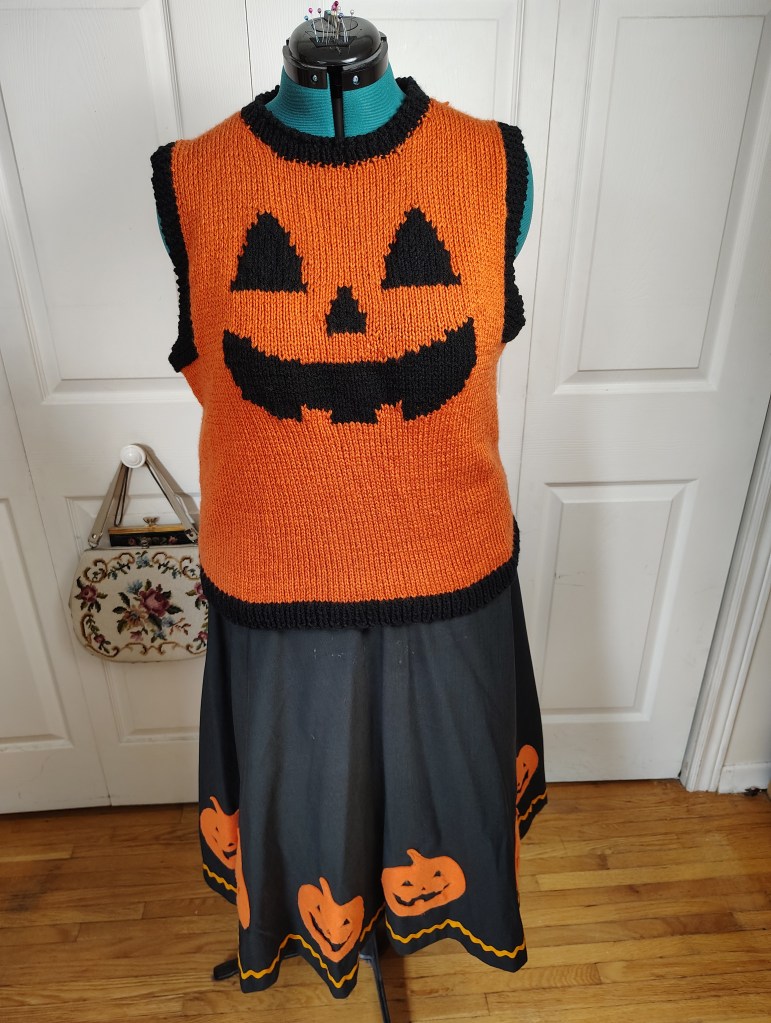
Next up is a sneak peek of a pattern that I’ll be releasing at the beginning of October. Currently, it is out to my testers, and I just finished all of my versions of it. Or rather, the ones I’m going to make for now, as I love this vest and I do want to make a few more. I am on the hunt for glow-in-the-dark yarn so I can do a glow-in-the-dark version of the ghost; however, the only one I could find so far as the gauge doesn’t match the yarn it was originally using. This is a super fun pattern to make. You can also forgo the intarsia images and just knit this plain. It’s super fast, and knitting it is a lot of fun. So stay tuned for that, and when I release it, it will be on my Patreon as well as on my Ravelry.
I am already starting to write up my next knitting pattern. I’m hoping to have it out to testers in the next month or so. I’m also hoping to have that one ready to go for Christmas!
I’m not going to show you a sneak peek of the next item as I am working away on my October Patreon project. It is another fun B-movie theme. Just so you know, for this year’s Patreon (it runs from August to the end of July), the theme is B-movies of the late 1940s up to the early 1960s. I am a super huge fan of B movies, as I’ve mentioned several times in videos.
I have a lot more exciting things for each month over on Patreon!
Because of all the stuff I’m doing on Patreon, I have not gotten very far in my forgotten ones pile of sewing. I’m hoping to have a day or two, or I can get through that and finish some of those off. So there really isn’t much of an update about that project.
This video was short and sweet, with a few updates about what’s going on! let me know what you’ve been working on.
If you enjoyed this video, please subscribe, give this video a thumbs up if you liked it and also, I now have memberships on this channel and those memberships do include early access to weekly videos, eventually I’ll do semi-regular members only chats, you’ll get discounts to new products, I’ll also do some members only posts, videos and possibly some tutorials shortly. It does not cost that much to join, and it helps out my channel.
Often in classic movies or movies set in eras such as the 1950s and before, you will see women knitting in an almost impossible form. Needles up, hands down, and knitting like their hands are on fire. This is called Parlor Knitting, and if you want to find out more about what exactly that is, watch this video.
As I mentioned in the intro, often in television and movies that are in historical settings or in classic movies, you will see many women knitting in a very peculiar style. That style is called Parlor Knitting. Before I talk about what that is, I think it’s important to talk about a few different styles of knitting so you can understand the differences. I want to do this because I have asked a few people what style they knit in, and they weren’t sure.
Firstly, what would make a knitting style different from the other? It’s a few different things. One, it could be the way that the yarn is being held in your hands. It could be the way that you’re picking up your stitches. It could be if you are throwing the yarn or picking the yarn up as you knit. All of those things determine what style you’re using.
What are the different styles of knitting that are most commonly used today? These would be English Knitting, where you’re throwing the yarn, and then Continental Knitting, where you’re picking the yarn up off the needle.
There are a couple more uncommonly used types of knitting called Portuguese and Norwegian knitting. I will explain what those are in a moment.
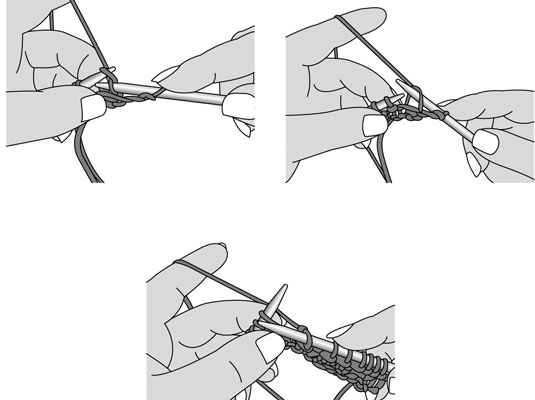
In English knitting, you’re throwing the yarn. What that means is the yarn is held in your right hand, and you throw or wrap the yarn around the needle to form the stitch.
Continental Knitting is also known as picking up the yarn. This is when you have the yarn held in your left hand, very similar to the style when you’re crocheting, and you would then pick up the stitch as you’re knitting. My own personal style is that I use English for the most part. It’s how my grandma taught me.
For Portuguese knitting, the attention is usually kept by having the yarn wrapped around your neck as opposed to keeping the tension in your hand. Norwegian knitting, you keep the work always close to the end of the needle tips, and in this case, the tension is also through your fingers.
There are also a few other styles in knitting. Armenian is another one, and I use this for Intarsia sometimes. It’s a way of working your stitches so that you don’t have really long floats when you’re doing Fairisle knitting. I know Intarsia, you’re supposed to not have any floats in it, but there are some occasions where that happens. There’s also double knitting, which I do want to try out one of these days, for scarves, and you’re knitting on both sides of the fabric. Then there’s Fairisle, which involves many different colors of yarn to create designs throughout your garments.
That now brings us to Parlor Knitting.
They say that parlor knitting was an invention of the Victorian era. During this period of time, Victorian women were now involving themselves in more leisurely activities, and knitting was definitely one of them. However, they did not want to knit purely for necessity, and it was definitely meant to be more of an entertainment style of hobby or activity. For them, it often became a competition or a performance piece on who could knit more beautifully. Not just the garment, but the way they were physically knitting that garment. It was also a way for them to differentiate themselves from people who were knitting purely for necessity. A way to distinguish themselves as more upper-class than everyone else.
Knitting was a way to show that they had a good virtue and a very good moral standing in society. Only good women would knit garments like baby bonnets or beautiful shawls to drape over their gorgeous, custom-made dresses. There were also mottoes going around, such as “Idle Hands, idle minds.” The fact that these women were at home knitting or knitting in groups with other women showed that they were keeping themselves busy and out of trouble. It was also a good way for them to escape the home, get into a group, and gossip. which kind of goes against that whole moral thing.
Women of this class would also be given the luxury of being able to buy finer yarns. Women of the lower classes would be buying yarns that were less processed, possibly weaving their own or reusing yarn from other garments that could no longer be used. In Victorian society, you were also seeing a great divide between the poor and the rich.
But now back to parlor knitting. It’s often one style of knitting that I would love to learn. I have attempted it a few times, and I cannot do it. It’s largely in part to the way that the needles are being held. Unfortunately, I cannot find my straight needles anywhere. I have a large selection of circulars, and I have a large selection of vintage and some antique knitting needles. I tidied up my yarn, and since then, they disappeared. However, I am going to show you on chopsticks how exactly you would hold your needles when parlor knitting.
One of these days, I am going to figure out how to do this, and if I can, I will do a tutorial about it.
To give you a little bit better visualization of what this looks like, if you have ever watched any classic British television or movies, and you see someone knitting in those movies, they are generally doing parlor knitting. In the Miss Marple television series, the character Miss Marple is an avid knitter, and you will see her knitting in that style. When I first started watching Miss Marple many, many moons ago, I was intrigued by this style. At this point, unfortunately, my grandma was no longer with us, and I couldn’t talk to her about it, and my mom had no clue what I was talking about. Both my mom and my grandma knit English style, and that was how my grandmother taught me how to knit. I have also attempted to try to learn Continental knitting, and if I could figure out how to get my hands to work for that, then it might be easier for me to attempt parlor knitting. However, to do either Continental or parlor knitting, I do need to find my straight needles.
I know the style of knitting was completely meant for performance; however, I honestly love the way it looks, and I also want to learn how to do this. Is there anyone out there who also wants to learn how to parlor knit? If I get enough interest, I will force myself to learn it so I can do a video tutorial. I think it will be both a fun and frustrating challenge; however, I would love to learn how to do it. If you enjoyed this video, please subscribe, give this video a thumbs up if you liked it and also, I now have memberships on this channel and those memberships do include early access to weekly videos, eventually I’ll do semi-regular members only chats, you’ll get discounts to new products, I’ll also do some members only posts, videos and possibly some tutorials shortly. It does not cost that much to join, and it helps out my channel.
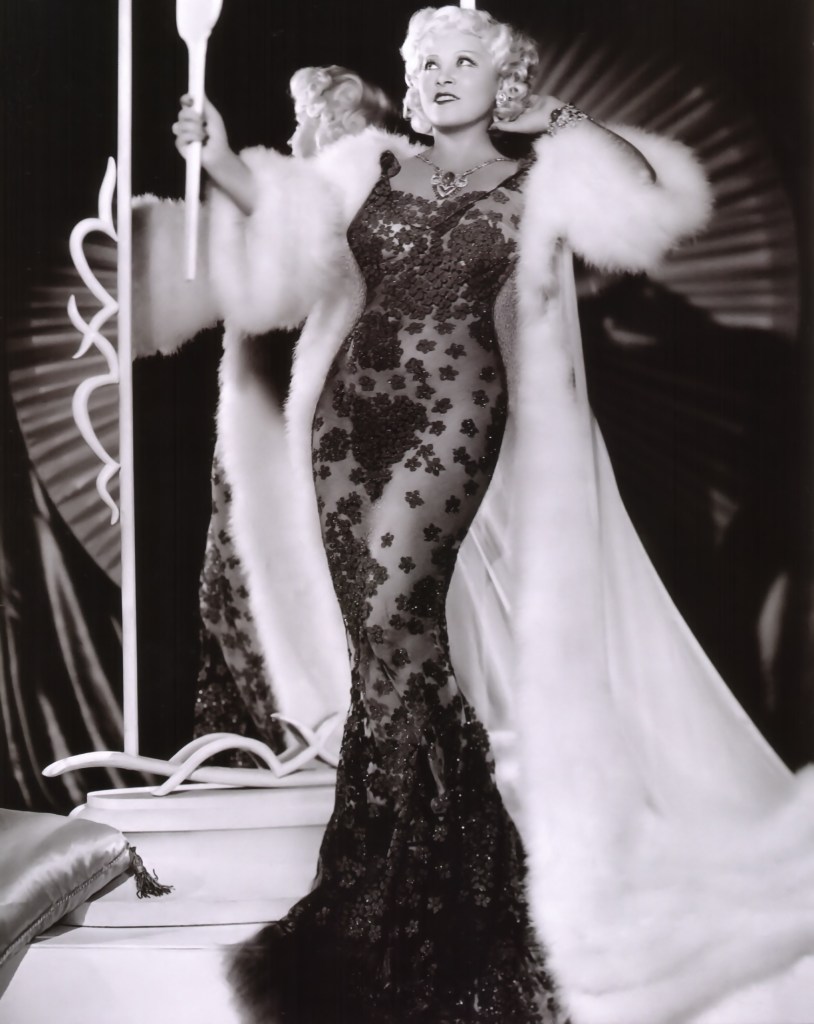
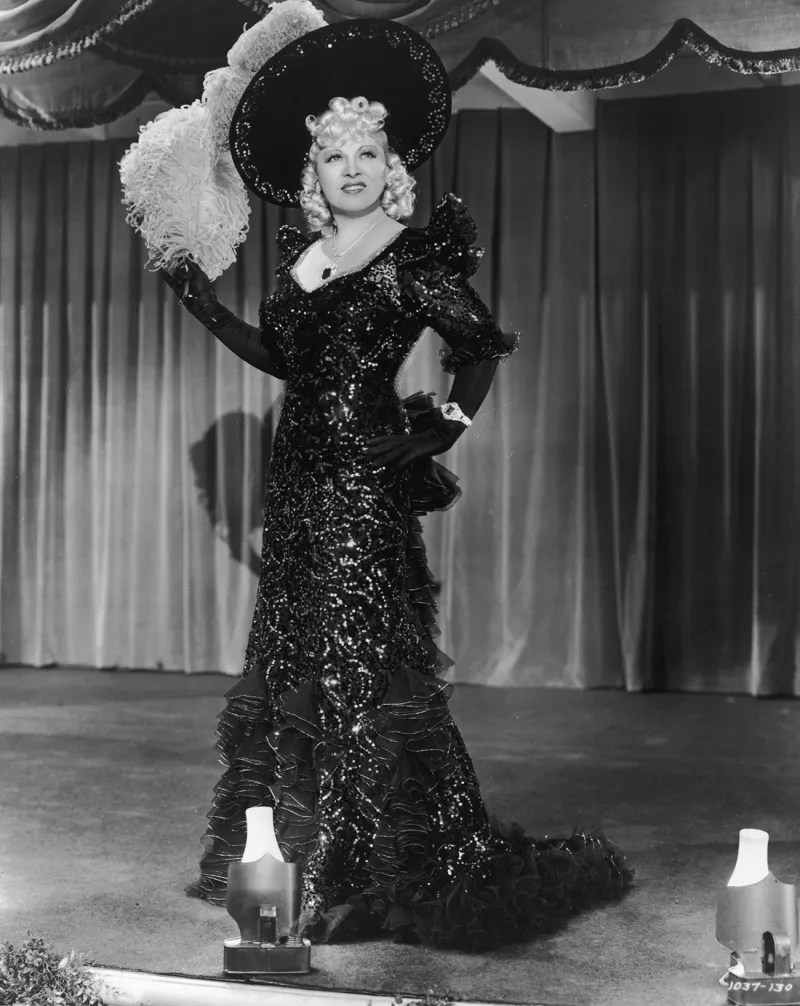
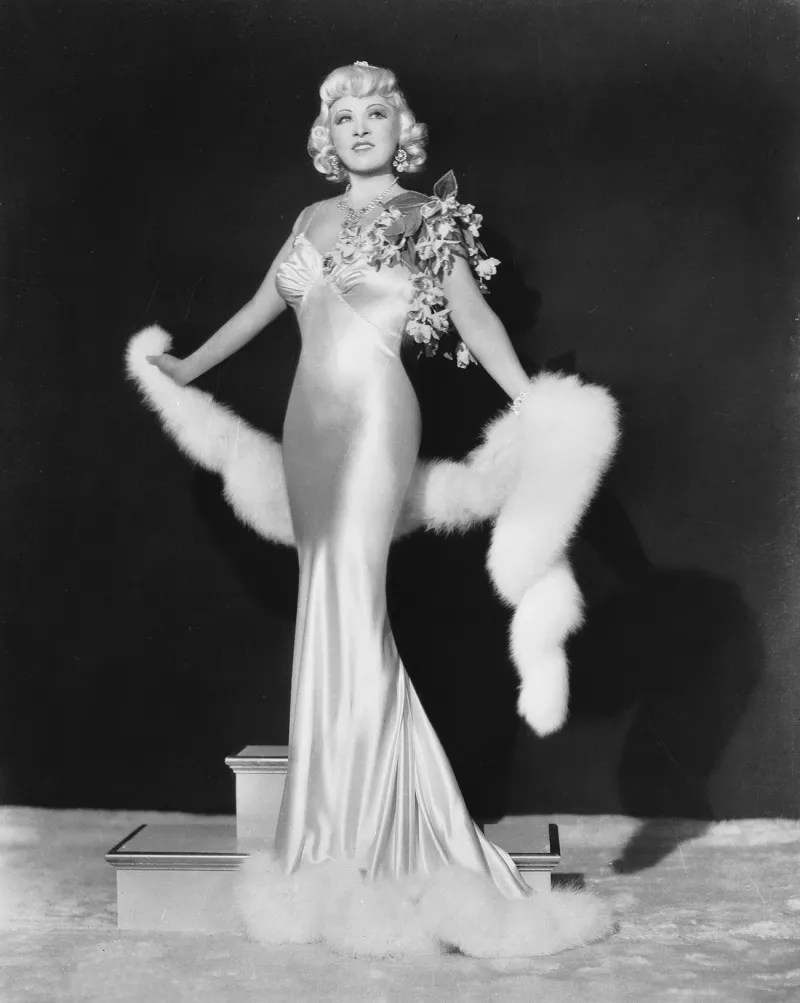
When you hear the name Mae West, many will automatically visualize a very voluptuous, platinum blonde, sassy, hip swaying, fast-talking dame! It was a character she would play in many of her movie roles; however, Mae West was so much more than what you saw on screen! She was not only an icon, she was someone that many women and men looked up to. If you want to learn more about this fascinating and sometimes controversial woman, watch this video.
As I mentioned in my opening, Mae West was visualized in a very specific way by both those who worked within the golden walls of Hollywood and the audience who absolutely loved seeing her presence on screen. However, Mae West was so much more than those tight-fitting, sparkly dresses, the platinum blonde hair, and that incredibly smart talking cadence she used. In today’s video, we’re going to talk about who Mae West was, some of her history, and I’m going to, of course, as I will always do, talk about her movies and show some of her sexy and inspiring style, because if you knew anything about Mae West, you knew that her curves just never stopped.
A little bit about Mae West’s beginnings. She was born Mary Jane West on August 17th, 1893, in Brooklyn, New York, and would eventually become known as a very popular actress, singer, comedian, screenwriter, and playwright. Her career was very long, though not always prosperous or easy. Of her 87 years on the planet, she worked about 70 of them.
When she started her career, she began breaking barriers almost immediately. She was an incredibly smart businesswoman, as well as very open sexually in both her life and her style. She was not going to hide who she was. Also, right from the beginning, she would become very well known for her very clever use of the double entendre. It sounded both poetic and musical. As with many performers starting at the time, she started out in Vaudeville and on New York City stages. I often dream about building a time machine and going back to the time of Vaudeville, and she is definitely on top of my list a performers I would have loved to have seen live. Also, I would have just loved to have met her in person. She’s always been an inspiration to me.
Something else that she started putting a fire under, very early in her career, is many controversies. I’m going to talk a little bit about those in a while. Along with Cary Grant, Mae West would also be one of the most misquoted actors of her time.
Also, as I mentioned above, she was not just a screen and a stage star; throughout her career, she was a singer, writer, playwright, and also appeared on radio and television. She was doing radio and television during a time when many film actors refused to do it. They felt like it was a step down in their careers; however, being a clever businesswoman, she wanted to make sure that her voice was everywhere.
Mae came from performance honestly. Her own parents were both in the entertainment industry. Her mother Mathilda, was a corset and fashion model, and her father, John Patrick, also known as Battling Jack West was a former prize fighter who later became a special policeman and founded a private investigation agency., The controversies started even before Mae was born.
Her mother, Mathilda or Matilda, was a German immigrant from Bavaria, and she arrived in the United States in 1886 with her family and Mae’s father’s family was of English and Scottish descent. Her parents got married in Brooklyn on January 18th, 1889, and apparently her father’s family had no problem with this union; however, her mother’s family was very strongly opposed to her marrying not only a fighter, but there were opposing religious views. However, that did not stop him from getting married, and thankfully, they did because we would not have had Mae West otherwise.
As I mentioned, performing was definitely in her blood, and even as a five or six-year-old old she was already performing for audiences. Now, at this point, not professionally, however, it was showing her parents that their daughter should be on stage. Then, at the age of seven, she had her first amateur performances, and she would very often win prizes at local talent contests. It wasn’t until 1907 that she finally started performing professionally. She was only 14 at that point, a true child performer. However, saying that, in Vaudeville, most of the acts or troupes had many family members within the troupe. Whether or not they were on stage or backstage, this included children.
One of her very first stage names was Baby Mae. After many years of amateur performances, she finally made her professional debut on Broadway in 1911. She was now at the ripe old age of 18. Her first performance was in a review called La Broadway, and though that was a very short run for a Broadway show, Mae herself got rave reviews from the New York Times. She then went on to perform in Vera Violetta with Al Jolson in 1912, and then she was in another play in 1912, called A Winsome Widow.
Mae’s Vaudeville and then eventual stage career were going quite well at this point; however, it was not enough. She also wanted to write for performances. However, what she wanted to write was considered very risque for the time. That, of course, was not going to stop Mae West. At this time, she was using a pen name, Jane Mast, and the first play that she wrote as well as starred in, in 1926, was a play called Sex. She not only wrote it, but she also produced and directed this play. Though it was very controversial and at that time, theater goers were pretty conservative, the box office was booming for this play. Then, city officials and police caught wind of the play, partly through word of mouth from some very upset religious groups. During that time, there was quite a bit of corruption within the city and the police forces, and normally, they would have been happy to have been paid off to look the other way; however, these religious groups were relentless and made it impossible for the police to just look the other way. So, they had to do something about it, and on April 19th, 1927, they raided the playhouse, and Mae was sentenced to 10 days in jail or she had the option to pay a fine, and Mae, being Mae, chose jail time. The reason it is suggested, or rumored, that she chose the jail time was because she knew it was going to be great publicity for her, and she was correct. When she was released from jail, the media was right there to talk to her about the entire incident. Not only did this media attention help her career, but it also got her the famous label that she would carry through most of her career, which is the bad girl.
After this whole incident and jail time, was she going to stop? Absolutely not. The next play that she wrote would be just as controversial. Her next play was called The Drag, and it dealt with homosexuality. Mae made every effort to get this play on Broadway; however, it seemed that many of the theaters had banned her from doing these types of performances again. Many blame the New York Society for the Suppression of Vice as the reason for her ban. I also just want to note here that Mae was a very active supporter of gay rights and often spoke publicly about gay men being beaten up or wrongly arrested by the police. She was very outspoken about it and would often do everything she could in her power to help these men out.
Throughout the 1920s and early 1930s, Mae West would continue to work on Broadway; every opportunity she could get, she would add spiciness to the plays she was in, and her public persona definitely would help with their box offices.
One of Mae’s most famous characters, while on Broadway, was a character named Diamond Lil. This would be one of the roles that she was most known and remembered for, and she would go on to reprise this role or a variation of the character in many of her movies.
Eventually, Broadway would no longer be enough for her, and she wanted to move on to motion pictures. Mae West was ready for Hollywood, but was Hollywood ready for her?
In 1932, she would make her way to Hollywood after signing a contract with Paramount Studios. Like many New York actors at the time, the studios were signing them without actually having specific roles or movies in mind. Also, by this point, she was much older than a lot of the actresses they would have been signing. In 1932, she would have already been on the cusp of turning 40. At that time, Hollywood would be casting anyone that age in mother roles, and that was something that Mae West was never going to do. She would fight tooth and nail to make sure that her on-screen characters were always very sexy, front and center.
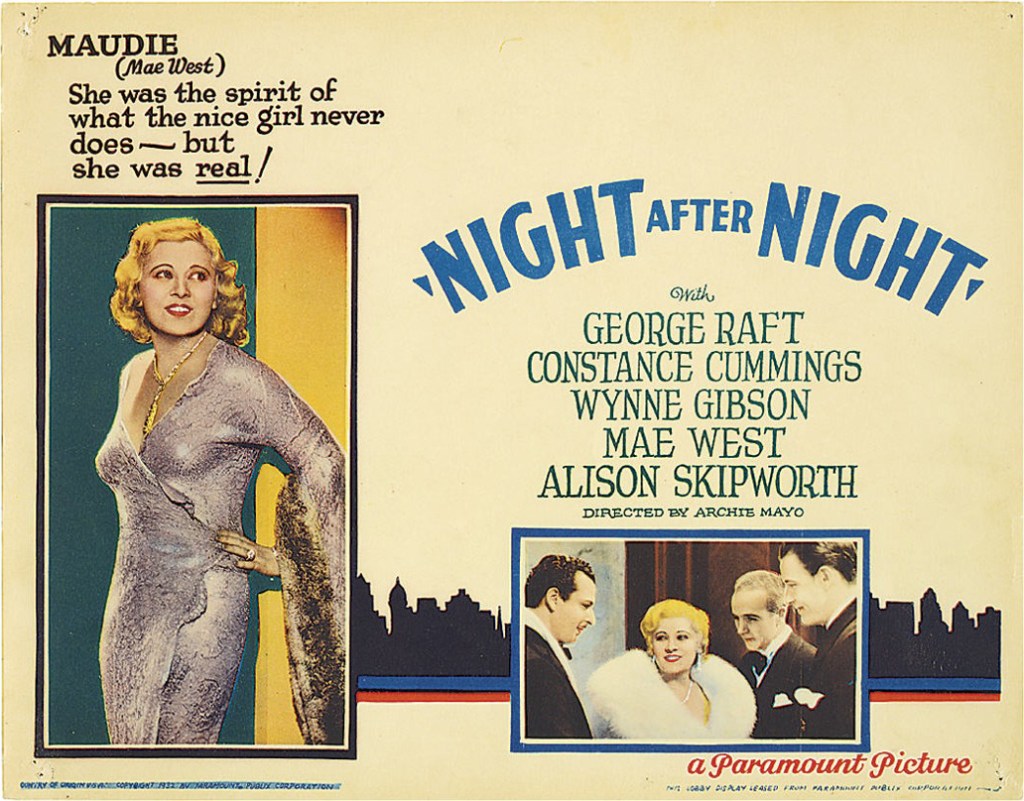
In 1932, she would make her screen debut in a movie called Night After Night, and it starred the very wonderful George Raft. There are rumors that he told the studio that he wanted her in his movie. Mae did not want to have a minor role in anything, and I’m sure after much discussion and persuasion, she was able to beef up that role, including rewriting some of her dialogue to be more Mae West.
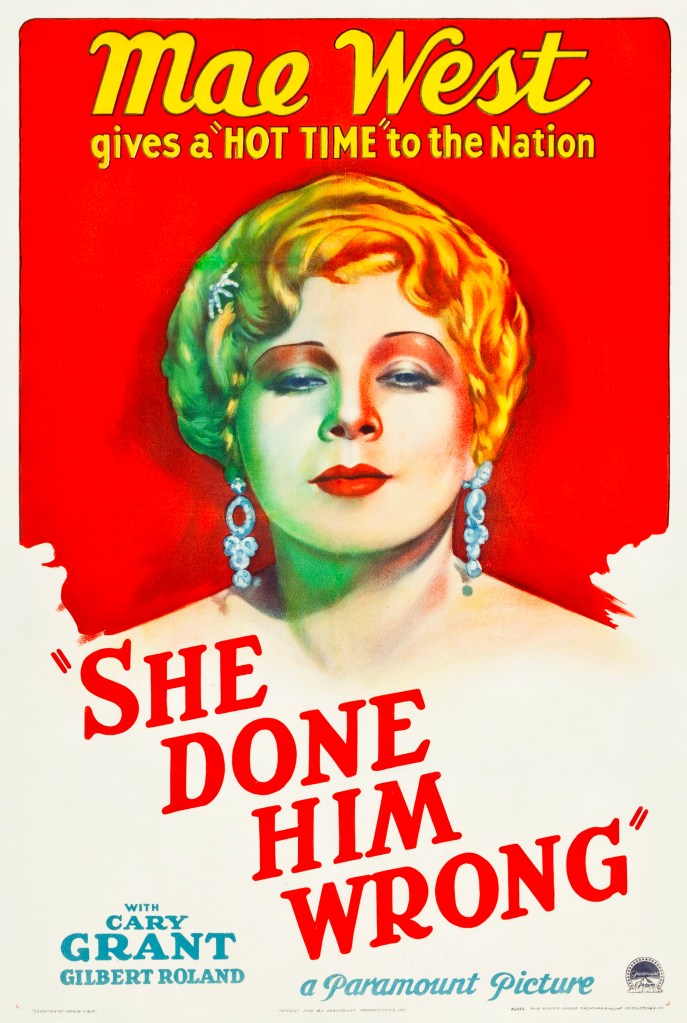
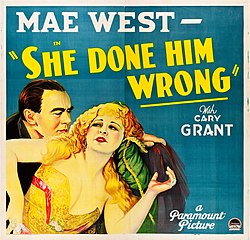
Next up for Mae was a movie called She Done Him Wrong, and that was in 1933. In this movie, Mae West brought her Diamond Lil character back to life, though she was called Lady Lou. Also, Cary Grant was in this movie. Rumor has it (I have heard that this has been exaggerated, and sometimes I hear this is completely true) that Mae West insisted Cary Grant be in this movie, and because of this and her supporting him, it boosted his career. The story is that Mae insisted that she spotted him somewhere in the studio and really loved how beautiful he was, and was very firm that he be the male lead in this movie. The director apparently agreed with her and was happy to cast him.
She Done Him Wrong was a huge box office success and was nominated for an Academy Award for Best Picture. Apparently, this movie also saved Paramount from bankruptcy.
This also wouldn’t be the only movie that Mae would star in with Cary Grant; they would go on to make a few more after this. The next one would be I’m No Angel, also in 1933. This was also a huge box office hit and was another major boost for Cary Grant.
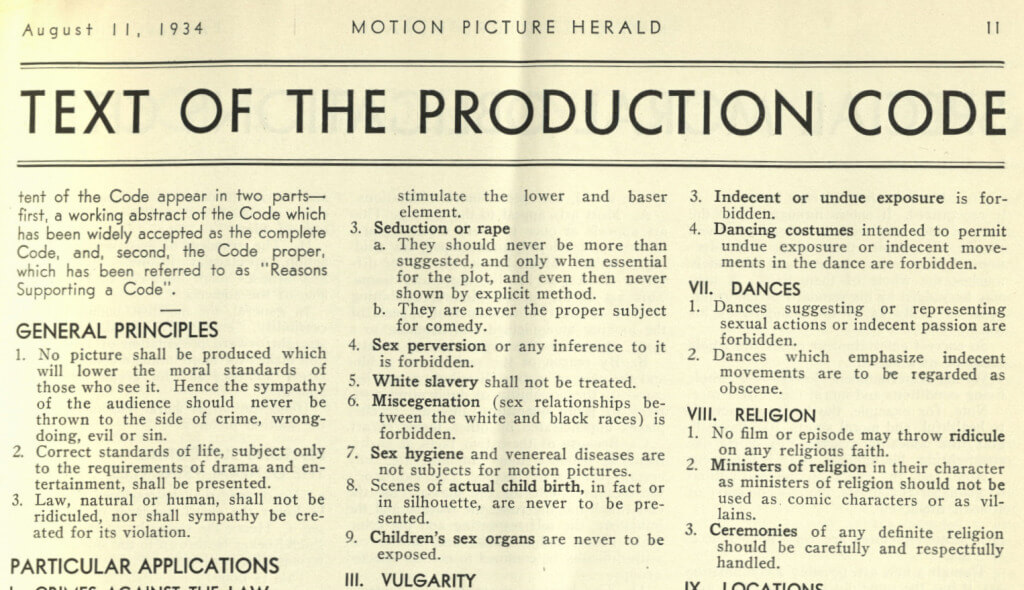
By the end of 1933, Mae West was one of Hollywood’s biggest box office draws. Everyone wanted to see her! By 1935, she was one of the highest-paid female actors at that time. She was definitely a pre-code delight! Then, as we all know, on July 1st, 1934, the Hays Code came into effect. If you know anything about the Hays Code, it was a production code that heavily censored language, sexuality, and violence in movies. Up until this point, movies were getting away with quite a lot. They had tried in previous years to enforce this code and didn’t have much luck; however, by July 1st, they were able to fully enforce it. Because of this, a lot of directors, writers, producers, and actors who became very famous for their pre-code antics off and on screen would have this affect their careers. Mae West was definitely one of those actors. Many of the scripts written after the code came into effect would have much of the personality that Mae West would be known for removed. Due to this, a lot of the movies she made after the code did not do well. Eventually, she would be included in the notorious box office poison list that many well-known actors and actresses were put on. It ruined many of their careers. Some other actors who were in that list were Edward Arnold, Greta Garbo, Joan Crawford, and Katharine Hepburn, just to name a few. Actresses like Joan Crawford and Katherine Hepburn were able to bounce back.
There was a little bit of box office hope in 1939 for Mae West when Universal Studios approached her to star in the W.C. Fields movie My Little Chickadee. Though it was a box office success, it didn’t do much to help revive Mae’s career to the heights it had been in the early 1930s.
Realizing that she would continue to struggle in the film industry, Mae then attempted television and radio. Right off the bat, many of the shows she guested on were sprinkled with her very saucy double entendres, causing controversy. With conservative and religious groups once again complaining about her, she eventually got banned by NBC. Of course, none of her male co-stars’ careers suffered from the controversy. That would only end her radio career for a while; she did return to radio again in 1950.
In the 1940s, Mae would work in a few more movies; then she would return to her stage career, as well as nightclub acts.
Some additional Mae West Trivia:
Her distinctive walk was said to have been inspired or influenced by female impersonators Bert Savoy and Julian Eltinge.
David O. Selznick offered her the role of Belle Watling in Gone with the Wind, but West declined, saying it was too small and would need rewriting.
During the casting of Billy Wilder’s 1950 film Sunset Boulevard, West was offered the role of Norma Desmond. She turned it down.
Among her achievements, in 1999, the American Film Institute ranked her 15th among the greatest female screen legends of classic American cinema.
That was just a highlight of Mae West’s career. Unfortunately, it’s difficult to get through everything in 20 to 30 minutes; however, I strongly recommend that you watch her movies and read some of the wonderful biographies about her. I’m going to list some of her movies, as well as some great biographies about her.
Movies:
Night After Night (1932)
She Done Him Wrong (1933)
I’m No Angel (1933)
Belle Of The Nineties (1934)
My Little Chickadee (1940)
The Heats On (1943)
Biographies:
Goodness had nothing to do with it: The Autobiography of Mae West by Mae West
She Always Knew How: Mae West: A Personal Biography by Charlotte Chandler
If you enjoyed this video, please subscribe, give this video a thumbs up if you liked it and also, I now have memberships on this channel and those memberships do include early access to weekly videos, eventually I’ll do semi-regular members only chats, you’ll get discounts to new products, I’ll also do some members only posts, videos and possibly some tutorials shortly. It does not cost that much to join, and it helps out my channel.
We’re just inviting you to take a timeout into the rhythmic ambiance of our breakfast, brunch and/or coffee selections. We are happy whenever you stop by.





























 Killer Kitsch Designs