

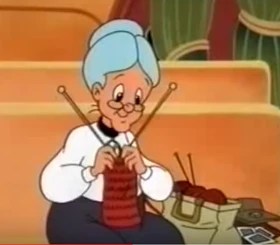
Often in classic movies or movies set in eras such as the 1950s and before, you will see women knitting in an almost impossible form. Needles up, hands down, and knitting like their hands are on fire. This is called Parlor Knitting, and if you want to find out more about what exactly that is, watch this video.
As I mentioned in the intro, often in television and movies that are in historical settings or in classic movies, you will see many women knitting in a very peculiar style. That style is called Parlor Knitting. Before I talk about what that is, I think it’s important to talk about a few different styles of knitting so you can understand the differences. I want to do this because I have asked a few people what style they knit in, and they weren’t sure.
Firstly, what would make a knitting style different from the other? It’s a few different things. One, it could be the way that the yarn is being held in your hands. It could be the way that you’re picking up your stitches. It could be if you are throwing the yarn or picking the yarn up as you knit. All of those things determine what style you’re using.

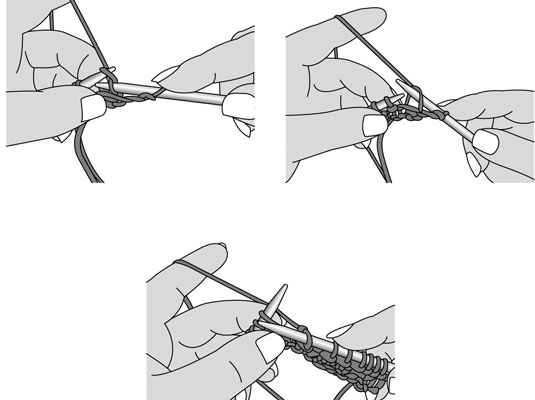
What are the different styles of knitting that are most commonly used today? These would be English Knitting, where you’re throwing the yarn, and then Continental Knitting, where you’re picking the yarn up off the needle.
There are a couple more uncommonly used types of knitting called Portuguese and Norwegian knitting. I will explain what those are in a moment.
In English knitting, you’re throwing the yarn. What that means is the yarn is held in your right hand, and you throw or wrap the yarn around the needle to form the stitch.
Continental Knitting is also known as picking up the yarn. This is when you have the yarn held in your left hand, very similar to the style when you’re crocheting, and you would then pick up the stitch as you’re knitting. My own personal style is that I use English for the most part. It’s how my grandma taught me.
For Portuguese knitting, the attention is usually kept by having the yarn wrapped around your neck as opposed to keeping the tension in your hand. Norwegian knitting, you keep the work always close to the end of the needle tips, and in this case, the tension is also through your fingers.

There are also a few other styles in knitting. Armenian is another one, and I use this for Intarsia sometimes. It’s a way of working your stitches so that you don’t have really long floats when you’re doing Fairisle knitting. I know Intarsia, you’re supposed to not have any floats in it, but there are some occasions where that happens. There’s also double knitting, which I do want to try out one of these days, for scarves, and you’re knitting on both sides of the fabric. Then there’s Fairisle, which involves many different colors of yarn to create designs throughout your garments.

That now brings us to Parlor Knitting.

They say that parlor knitting was an invention of the Victorian era. During this period of time, Victorian women were now involving themselves in more leisurely activities, and knitting was definitely one of them. However, they did not want to knit purely for necessity, and it was definitely meant to be more of an entertainment style of hobby or activity. For them, it often became a competition or a performance piece on who could knit more beautifully. Not just the garment, but the way they were physically knitting that garment. It was also a way for them to differentiate themselves from people who were knitting purely for necessity. A way to distinguish themselves as more upper-class than everyone else.

Knitting was a way to show that they had a good virtue and a very good moral standing in society. Only good women would knit garments like baby bonnets or beautiful shawls to drape over their gorgeous, custom-made dresses. There were also mottoes going around, such as “Idle Hands, idle minds.” The fact that these women were at home knitting or knitting in groups with other women showed that they were keeping themselves busy and out of trouble. It was also a good way for them to escape the home, get into a group, and gossip. which kind of goes against that whole moral thing.

Women of this class would also be given the luxury of being able to buy finer yarns. Women of the lower classes would be buying yarns that were less processed, possibly weaving their own or reusing yarn from other garments that could no longer be used. In Victorian society, you were also seeing a great divide between the poor and the rich.

But now back to parlor knitting. It’s often one style of knitting that I would love to learn. I have attempted it a few times, and I cannot do it. It’s largely in part to the way that the needles are being held. Unfortunately, I cannot find my straight needles anywhere. I have a large selection of circulars, and I have a large selection of vintage and some antique knitting needles. I tidied up my yarn, and since then, they disappeared. However, I am going to show you on chopsticks how exactly you would hold your needles when parlor knitting.

One of these days, I am going to figure out how to do this, and if I can, I will do a tutorial about it.
To give you a little bit better visualization of what this looks like, if you have ever watched any classic British television or movies, and you see someone knitting in those movies, they are generally doing parlor knitting. In the Miss Marple television series, the character Miss Marple is an avid knitter, and you will see her knitting in that style. When I first started watching Miss Marple many, many moons ago, I was intrigued by this style. At this point, unfortunately, my grandma was no longer with us, and I couldn’t talk to her about it, and my mom had no clue what I was talking about. Both my mom and my grandma knit English style, and that was how my grandmother taught me how to knit. I have also attempted to try to learn Continental knitting, and if I could figure out how to get my hands to work for that, then it might be easier for me to attempt parlor knitting. However, to do either Continental or parlor knitting, I do need to find my straight needles.

I know the style of knitting was completely meant for performance; however, I honestly love the way it looks, and I also want to learn how to do this. Is there anyone out there who also wants to learn how to parlor knit? If I get enough interest, I will force myself to learn it so I can do a video tutorial. I think it will be both a fun and frustrating challenge; however, I would love to learn how to do it. If you enjoyed this video, please subscribe, give this video a thumbs up if you liked it and also, I now have memberships on this channel and those memberships do include early access to weekly videos, eventually I’ll do semi-regular members only chats, you’ll get discounts to new products, I’ll also do some members only posts, videos and possibly some tutorials shortly. It does not cost that much to join, and it helps out my channel.
I have a Patreon. I would love it if you became a member. https://www.patreon.com/killerkitschdesigns
If you are inclined, I have a Ko-Fi account. All donations are appreciated and will help me upgrade my equipment (lighting, microphones etc).
Thank you so much! https://ko-fi.com/killerkitschlizzie
Other links to follow! Discord: https://discord.gg/yPeZRJpWpk
Instagram: https://www.instagram.com/killerkitsch13/
Facebook: https://www.facebook.com/killerkitsch13
Website: https://killerkitschdesigns.com/
 Killer Kitsch Designs