1800s, 1920s, 1930s, 1940s, 1950s, 1960s, adjustable skirt, rebellious fashion

Rebellious Fashion: The History of Skorts

When you hear the word skort, you are likely to visualize part of an outfit that a tennis or golf player might be wearing. Did you know that skorts have a much richer history than that? Did you know they were once considered rebellious fashion? If you want to find out more. Watch this video!

In my continuing series about rebellious fashion, today, we’re talking about the skort!

Before I get into the history, for anyone wondering what a skort is, let me explain. 

A skort is a combination of shorts and a skirt. The current design has a flap of fabric that covers the entire front of your shorts. If you look at female tennis players, you will generally see them wearing this garment. The beginnings of skorts started long before modern times!

Beginning around the 1890s, women began cycling. A huge fad that women felt they should be able to be a part of. However, their heavy skirts did not allow for them to do this with ease. Being able to use a bicycle also allowed women even more freedom. You also need to remember that we also have the Suffrage movement happening at this time, so every little bit of independence was a huge win. It is rumoured that many of those leading the movement enjoyed being able to utilize a way of transportation that only men did.

The original skort was more like a very voluminous pair of trousers. This allowed freedom of movement for the female cyclist, as well as allowing them to safely use the bicycle. You can just imagine getting one of those long and bulky skirts caught in a bicycle chain. That would have led to some serious injuries.

How did these trousers fare? Not very well. At that time, women simply did not wear trousers. According to society, it took away from their femininity. Trousers were meant for men. After getting a taste of the freedom of cycling as well as trousers, many women didn’t want to go back. This had women rethinking the clothing they were currently wearing. Restrictive corsets, huge skirts, bustles, and sleeves. In addition to trousers being meant for men, the cycling trousers would do something shocking to society. It exposed women’s ankles. Women would still be wearing wool stockings with their cycling trousers, but… society still had issues with this.

Could there be a compromise? 

French designers would have the answer.

Always innovators of fashion, French designers were the first to evolve the cycling trousers into skorts! The French creation would be the trouser skirts. This allowed the freedom of trousers while continuing to keep modesty in check. In 1911, Paul Poiret produced several designs that were a combination of skirts and trousers, which were known as jupe-culottes, or also known as harem pants. 

In the 1930s, there was a fitness craze and the desire to have more athletic-looking bodies. Because of this, even more women were taking up sports, especially tennis and golf. The skort also became popular as everyday wear. Skorts were still fairly long at this time, and it wasn’t uncommon for a woman to wear wool stockings with them. 

In 1931, enter one of our favourite rebellious fashion designers, Elsa Schiaparelli! Elsa designed a pair of skorts for Spanish tennis player Lili Alvarez. This version of the skort was a pair of culottes (which Elsa is well known for), with a piece of fabric draped across the front for modesty. It was the first time that skorts had been worn to Wimbledon. Some of the audience members were aghast and vocal with their thoughts on the skort. When it was worn at the French Open, the audience was much more relaxed about it. 

In the 1930s, you would also see women in college adapting skorts as part of their athletic uniforms!

Then the skort lost popularity. They were still being used in sports, but not in everyday wear. At this point, it was no longer considered taboo for women to wear trousers, and the skort lost its edge. 

Then, in 1959, the skort reappeared in a 1959 Spring/Summer Montgomery Ward catalogue. In this version of the skort, it was a pleated skirt with shorts underneath the skirt. 

Welcome to the 1960s and short hemlines, skorts evolved again to fit with those styles and would remain short for the most part, up until today.

Today, skorts are fashionable in sports and everyday wear. As everyday wear, you get the best of both worlds, shorts and a skirt. Perfect for breezy summer days! However, their history is much more important than that. They were a very important part of feminism, allowing women to participate in the same luxuries as men, from cycling to sports. It was a rebellious statement, and we should always remember that.

At some point in the near future, I plan on self-drafting a skort and will have a tutorial for that.

Other links: 

Rebellious Women of the 1920’s: https://youtu.be/rYlkmwHPNFU 

Rebellious Fashion: Hatpins: https://youtu.be/fkw-5-PbAPc 

I hope you enjoyed this video. Please subscribe and give this video a thumbs up if you liked it. Also, I now have memberships on this channel, and those memberships include early access to weekly videos. Eventually, I’ll do semi-regular members-only chats, and you’ll get discounts on new products. I’ll also do some members-only posts, videos, and possibly some tutorials shortly. It does not cost that much to join, and it helps out my channel.
I have a Patreon. I would love it if you subscribed!  https://www.patreon.com/killerkitschdesigns
I have a Ko-Fi account if you are inclined. All donations are appreciated and will help me upgrade my equipment (lighting, microphones, etc.). 
Stay Kitschy T-shirt! https://ko-fi.com/s/d1c506b10f

Thank you so much!  https://ko-fi.com/killerkitschlizzie

Other links to follow! Discord: https://discord.gg/yPeZRJpWpk

Instagram: https://www.instagram.com/killerkitsch13/

Facebook: https://www.facebook.com/killerkitsch13
knitting, knitting community, vintage knitting, vintage knitting patterns

Fall/Winter Knitting Plans!

Check out my latest video on YouTube!

1920s, 1930s, 1940s, 1950s, 1960s, cricut, cricut air explore 2, haslam, haslam drafting system, haslam system of dresscutting, knitting, knitting community, sewing, vintage knitting, vintage sewing

The Haslam System of Dresscutting: Creating a toile

In this video, I am going to show you how to create your toile! I will also be adding some tips and tricks throughout the video.

Supplies you will need.

  • Pattern pieces
  • Toile fabric
  • Sewing machine
  • Fabric scissors
  • Pins
  • Contrasting thread – easier for fitting
  • Marker – I use this in the fitting phase

If you enjoyed this video, please consider liking this video and subscribing.

That’s it for now. Thank you for watching. Stay kitschy and I will see you soon!

Thank you for watching! Please subscribe and tell your friends! 

If you are inclined, I have a Ko-Fi account. All donations are appreciated and will help me upgrade my equipment (lighting, microphones etc). Thank you so much! 

https://ko-fi.com/killerkitschlizzie

Other links to follow! 

Discord: https://discord.gg/yPeZRJpWpk 

Instagram: https://www.instagram.com/killerkitsch13/ 

Facebook: https://www.facebook.com/killerkitsch13 

Website: https://killerkitschdesigns.com/

1920s, 1930s, 1940s, 1950s, 1960s, cricut, cricut air explore 2, haslam, haslam drafting system, haslam system of dresscutting, knitting, knitting community, sewing, vintage knitting, vintage sewing

The Haslam System of Dresscutting: Creating the pattern pieces

In this episode, I am going to show you how to use your pattern block to create pattern pieces from the pattern block/sloper. I will also show you how to create the facing pieces.

Supplies you will need:

  • Template
  • Pattern block/sloper
  • Tracing paper
  • Pattern 
  • Pencil
  • Marker
  • Eraser
  • Pencil sharpener

A few things to note. These patterns don’t come with a seam allowance and most cases the facings. For the pattern pieces, I add a ⅜” or a ⅝” seam allowance (or seam allowance of your preference.

Back pattern piece

Front pattern piece

If you enjoyed this video, please consider liking this video and subscribing.

That’s it for now. Thank you for watching. Stay kitschy and I will see you soon!

Link to where to buy the pattern book we will be working from: https://www.etsy.com/ca/listing/945123558/the-haslam-system-of-dresscutting?click_key=f7158d4cc9a382a9e71341d1702d6fa08eb33a74%3A945123558&click_sum=1644bd67&ref=shop_home_active_21&pro=1&sts=1 

Thank you for watching! Please subscribe and tell your friends! 

If you are inclined, I have a Ko-Fi account. All donations are appreciated and will help me upgrade my equipment (lighting, microphones etc). Thank you so much! 

https://ko-fi.com/killerkitschlizzie

Other links to follow! 

Discord: https://discord.gg/yPeZRJpWpk 

Instagram: https://www.instagram.com/killerkitsch13/ 

Facebook: https://www.facebook.com/killerkitsch13 

Website: https://killerkitschdesigns.com/

1920s, 1930s, 1940s, 1950s, 1960s, cricut, cricut air explore 2, haslam, haslam drafting system, haslam system of dresscutting, knitting, knitting community, sewing, vintage knitting, vintage sewing

The Haslam System of Dresscutting: Creating the Sloper/Pattern Block

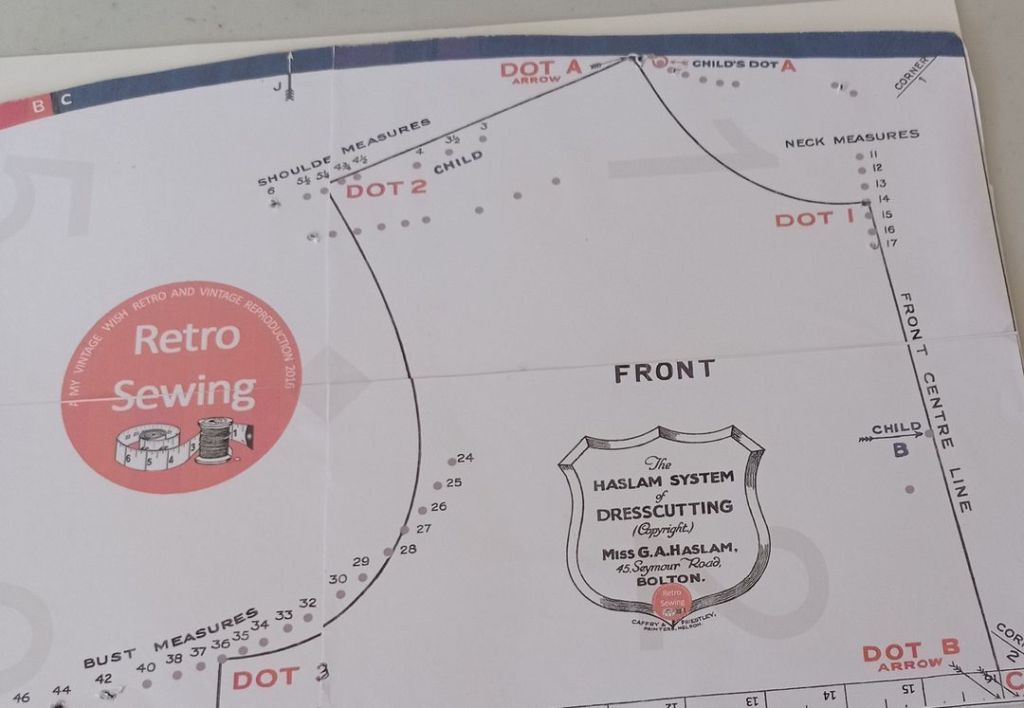
Today we’re going to build the front and back sloper/pattern block. Do you have your tools ready!!!

As I mentioned in the previous video, you will need a few items. 

  • The .pdfs
  • Some kind of tracing paper or large sheets of something. I personally use brown packing paper to draw my patterns on.
  • Poster board or as we call it in Canada Bristol board. I glue my template to it, to give it more structure. You will also use the poster board to make your pattern block. 
  • Pencils, pencil sharpener, eraser, and markers. 
  • Paper scissors
  • Glue of some sort. Elmer’s glue works, but I personally preferred using a glue stick. It was easier for me.
  • I also found an awl as a handy tool for punching the holes.

Please also see my blog post on Patreon for this information (free):  https://www.patreon.com/posts/haslam-system-of-87543607

Now. Let’s put together the back pattern block!

Alright! We have our pattern blocks ready to go. In the next video, I will show you have to draft your pattern! Please make sure you have already downloaded the pattern book. I will link it again below.

Back Sloper

Front Sloper

If you enjoyed this video, please consider liking this video and subscribing.

That’s it for now. Thank you for watching. Stay kitschy and I will see you soon!

Thank you for watching! Please subscribe and tell your friends! 

If you are inclined, I have a Ko-Fi account. All donations are appreciated and will help me upgrade my equipment (lighting, microphones etc). Thank you so much! 

https://ko-fi.com/killerkitschlizzie

Other links to follow! 

Discord: https://discord.gg/yPeZRJpWpk 

Instagram: https://www.instagram.com/killerkitsch13/ 

Facebook: https://www.facebook.com/killerkitsch13 

Website: https://killerkitschdesigns.com/

1920s, 1930s, 1940s, 1950s, 1960s, cricut, cricut air explore 2, haslam, haslam drafting system, haslam system of dresscutting, knitting, knitting community, sewing, vintage knitting, vintage sewing

The Haslam System of Dresscutting: How to make a template!

Hello and welcome to Killer Kitsch Lizzie! My little world where I sew, knit, and go on vintage reproduction journeys! 

Today we are going to build a template! Do you have your tools ready!!!

As I mentioned in the previous video, you will need a few items. 

*The .pdfs

*Some kind of tracing paper or large sheets of something. I personally use brown packing paper to draw my patterns on.

*Poster board or as we call it in Canada bristol board. I glue my template to it, to give it more structure. You will also use the poster board to make your pattern block. 

*Pencils, pencil sharpener, eraser, and markers. 

*Paper scissors

*Glue of some sort. Elmer’s glue works, but I personally preferred using a glue stick. It was easier for me.

*I also found an awl as a handy tool for punching the holes.

Now. Let’s put together the template!!!

Thank you for watching! Please subscribe and tell your friends! 

If you are inclined, I have a Ko-Fi account. All donations are appreciated and will help me upgrade my equipment (lighting, microphones etc). Thank you so much! 

https://ko-fi.com/killerkitschlizzie

Other links to follow! 

Discord: https://discord.gg/yPeZRJpWpk 

Instagram: https://www.instagram.com/killerkitsch13/ 

Facebook: https://www.facebook.com/killerkitsch13 Website: https://killerkitschdesigns.com/

1920s, 1930s, 1940s, 1950s, 1960s, cricut, cricut air explore 2, haslam, haslam drafting system, haslam system of dresscutting, knitting, knitting community, sewing, vintage knitting, vintage sewing

The Haslam System of Dresscutting! Getting Started!

Hello and welcome to Killer Kitsch Lizzie! My little world where I sew, knit, and go on many fun and sometimes weird creative journeys! 

Finally. Finally! The Haslam Journey begins. I’ve been promising this for a long time and now it’s here! I would love it if you came along with me!

So… In this video: 

  • I’m going to give some background on what draft-a-home systems are. A wee bit of a history lesson of what Haslam is and how it came to be. What materials you will need and how the series of videos will be broken down.
  • What is a draft-at-home system?
  • What is Haslam?

What I will show you in the next videos is:

  • How to put together the template.
  • How to use the template to create a pattern block.
  • How to use the pattern block to draft your first pattern.
  • How to make your toile and I will also show you my final garment.
  • Resources on where to find the template, patterns etc.

What is a draft-at-home system?

A draft-at-home system is a dressmakers tool that allows you to create your own sewing patterns, using your own body measurements or for whomever you are creating a garment for. You can also use the pattern to create different sizes as well as tailor the pattern to fit your body type. There are many types of garments you can use this system for such as tops, coats, skirts, dresses, trousers and even lingerie. You can also use this system to draft clothing for men and children. Which most mothers would normally do.

The Haslam System of Dresscutting does exactly the same thing and is achieved by creating a sloper and from that sloper or pattern block, you create pattern pieces. The system was devised by Miss Grace Haslam (in the 1930s I believe) and was an original home business that eventually has Miss Haslam traveling all over the country teaching her method of dressmaking.  There is a very sweet article written about her and I will link it below. 

OK! In our next video will get started with putting together our template and drafting our partner block. 

You will need a few things to get started. I know this might sound a bit overwhelming, but it’s not really more items than if you were tracing out a pattern.

Supplies you will need:

  • You will need to get yourself 2 PDFs. (there will be links below for places to buy these)
    •  copy of the Haslam template and the Foundations Draftings with Instructions. I am going to leave links below for where I purchased my .pdf.
    • Unfortunately, I don’t have a free copy to provide. I am on the hunt for Haslam books and a physical template. Hopefully, one day I will find originals.
  • A ruler. The template is an actual ruler, but I found it helpful to still have a ruler handy.
  • Measuring tape. You will need to take some important body measurements. I have also written a blog post with these steps and will link it below. You might also want someone to help you with the measurements. Some of them are your back and shoulders. It can be done on your own. I did it myself. 
  • Some kind of tracing paper or large sheets of paper. I personally use brown packing paper to draw/draft my patterns on.
  • Poster board or as we call it in Canada bristol board. I glue my template to it, to give it more structure. You will also use the poster board to make your pattern block. 
  • Pencils, pencil sharpener, eraser, and markers. 
  • Paper scissors
  • Glue of some sort. Elmer’s glue works, but I personally preferred using a glue stick. It was easier for me.
  • I also found an awl as a handy tool for punching the holes.

I’m also going to list all of the sellers I know who have .pdf booklets for patterns. There are way more options now than when I first started teaching myself Haslam.

If you enjoyed this video, please consider liking this video and subscribing.

That’s it for now. Thank you for watching. Stay kitschy and I will see you soon!

Link to free blog posts on Patreon that will also take you step by step through the process: https://killerkitschdesigns.com/?s=haslam

Facebook group – Haslam Sewing Support Group: (not mine) https://www.facebook.com/groups/HaslamSewing/ 

Article about Miss Haslam: https://www.theboltonnews.co.uk/news/10772216.history-of-the-haslam-sewing-system/ 

Link to where to buy template and Foundations Draftings with 

Instructions: 

My Vintage Wish. (template and instruction book)

https://www.etsy.com/uk/listing/258854147/haslam-system-of-dresscutting-pattern?ref=shop_home_active_16&pro=1

Another option for just the instruction book: 

That Darned Patch: 

Pattern book we will be working from: https://www.etsy.com/ca/listing/945123558/the-haslam-system-of-dresscutting?click_key=f7158d4cc9a382a9e71341d1702d6fa08eb33a74%3A945123558&click_sum=1644bd67&ref=shop_home_active_21&pro=1&sts=1 

Other sellers:

Moonflower Vintage: https://www.etsy.com/ca/shop/MoonflowerVintageAHJ?ref=shop-header-name&listing_id=1386726695&section_id=34586295

That Darned Patch: https://www.etsy.com/ca/shop/ThatDarnedPatch?ref=shop-header-name&listing_id=1228236385&section_id=36272044 

Fleureve Vintage: https://www.etsy.com/ca/shop/FleureveVintage?ref=shop-header-name&listing_id=1014387209&section_id=33684410 

eNeedlecrafts: https://www.etsy.com/ca/shop/eNeedlecrafts?ref=shop-header-name&listing_id=214299111&section_id=16259484 

Mrs. Depew: https://www.etsy.com/ca/shop/Mrsdepew?ref=shop-header-name&listing_id=616329911&section_id=36359979 

Museum All Things: https://www.etsy.com/ca/shop/MuseumAllThings?ref=shop-header-name&listing_id=1443176625 

My Vintage Wish: https://www.etsy.com/ca/search?q=haslam&ref=pagination&page=3 

Thank you for watching! Please subscribe and tell your friends! 

If you are inclined, I have a Ko-Fi account. All donations are appreciated and will help me upgrade my equipment (lighting, microphones etc). Thank you so much! 

https://ko-fi.com/killerkitschlizzie

Other links to follow! 

Discord: https://discord.gg/yPeZRJpWpk 

Instagram: https://www.instagram.com/killerkitsch13/ 

Facebook: https://www.facebook.com/killerkitsch13 

Website: https://killerkitschdesigns.com/

1920s, 1930s, 1940s, 1950s, 1960s, cricut, cricut air explore 2, haslam, haslam drafting system, haslam system of dresscutting, knitting, knitting community, sewing, vintage knitting, vintage sewing

Announcement!

Finally! The Haslam Journey begins!

On September 1st, join me on YouTube for the Haslam System of Dresscutting Series. In the series, I will take you through each step to make that Haslam garment you’ve been dreaming of!

A new episode will be available every Friday at 8 am throughout September, beginning with how to make the template and ending with a final garment! This series will prepare you for all the other Haslam content I have planned for the near future!

Please subscribe to my channel so you don’t miss an episode!

Link to YouTube channel: https://youtube.com/@killerkitschvintagelizziehttps://youtube.com/@killerkitschvintagelizzie

I have also started a Patreon. I will have additional blogs, vlogs, and information for projects there. Here is the link if you want to join. https://www.patreon.com/killerkitschdesigns